
Running a Sex Offender Check in Lexington County
The main public channel is the South Carolina Sex Offender Registry Tool, known as SORT. SLED and county sheriffs jointly supply the system. A Lexington County search can begin with a person's name or with a place such as an address, city, ZIP code, or county. The conditions screen and CAPTCHA come before the search controls. That gate helps limit automated misuse, but it also means a saved result link may not reopen the same profile later.
Use enough facts to make a sound match. Names and aliases can overlap. A map marker alone is not identity proof. Read photographs, physical details, conviction information, registration status, and the registering jurisdiction together. SLED cautions that an address or other registrant-supplied fact can change fast and may await verification. Inclusion reflects a qualifying conviction and a duty to register. It does not warn that a person is engaged in a current offense.
Lexington County Registry Gateway
Lexington County has an official county-specific SORT gateway. It presents the conditions of use before sending a visitor into the registry search. The local route and SLED's state route draw from the same public registration system. Neither is part of SLED CATCH, the state's name-based criminal-history product. CATCH can show fingerprint-supported South Carolina arrests and reported dispositions, while SORT answers the distinct question of current or historical registration data made public by statute.
That split prevents a common error. A clean CATCH result does not clear the registry, and a SORT profile does not replace the court file for the underlying conviction. For a Lexington County sex offender record, use SORT first. If a conviction detail needs more context, the maintaining court is the source for its docket and final judgment.
Note: Lexington County registry results should be matched against the complete profile, not against a name or map point by itself.
Searching the South Carolina Sex Offender Registry Tool
SORT provides both identity and location paths. Start with the route that fits the safety question, then narrow the results before opening a profile. The community-notification option is separate from a one-time search. SLED states that users of the newer SORT system must sign up again even if they had alerts through an older version.
- Open the official SLED registry page, read the conditions of use, and continue through the CAPTCHA.
- Choose a name search or a location search using the address, city, ZIP code, or Lexington County filter offered by SORT.
- Compare the result list with known aliases, photographs, physical traits, and registering jurisdiction.
- Open the complete profile, note its status, offense information, and address context, then use the sheriff or SLED for needed follow-up.
| Field or Control | Type | Required | Use |
|---|---|---|---|
| CAPTCHA code | Text | Yes | Opens the search gateway after conditions are accepted |
| Name search | Text fields | Alternative | First and last name; aliases can affect matching |
| Location search | Address, city, ZIP, or county | Alternative | Supports place and proximity review where offered |
| Community Notifications | Registration form | No | Creates alerts; the newer SORT system needs a new signup |
| Continue, Search, Clear | Buttons | As needed | Moves through the gateway or resets entered criteria |
A Lexington County registry search can be repeated through either route if the first criteria are too broad. Change one field at a time, record the jurisdiction shown on a likely match, and use the complete Lexington County profile for the next check. That method keeps similar names from being merged and makes later contact with the sheriff or SLED more precise.
Lexington County Registry Address Checks
Address data needs care. SLED warns that information supplied by a registrant can change quickly and may not yet have been verified. The public map is useful for community awareness, but it should not be treated as a live location tracker. A profile may carry mapped residence information at the level the law permits, along with a registration or compliance status and the jurisdiction responsible for the record.
When a Lexington County registry address seems wrong, preserve the profile details and contact the Lexington County Sheriff or the SLED Sex Offender Registry Unit. Do not confront anyone. Suspected noncompliance is an official follow-up issue, not a task for a neighbor. SLED accepts registry questions at 803-896-2601 and sor@sled.sc.gov, and it lists the SOR Unit at P.O. Box 21398, Columbia, SC 29210.
What a Registry Profile Shows
A SORT profile combines identity, conviction, location, and compliance fields. Read them as one record. A photograph can help distinguish people with similar names, while aliases explain why a search under one spelling may miss an entry. Conviction fields give the offense and jurisdiction behind the registration duty. Public address and vehicle details may appear when entered and legally available, but locally configured fields can vary.
| Name & Aliases | Current name plus alternate names recorded for matching |
|---|---|
| Photographs & Description | Current and historical photographs, physical traits, and identifying marks where entered |
| Registered Address | Residence and mapped location information at the public level allowed by law |
| Offense & Jurisdiction | Qualifying sex-offense conviction, statute, conviction facts, and originating jurisdiction |
| Registration Status | Compliance information and the jurisdiction responsible for registration |
| Other Public Data | Vehicles and related registration facts when SORT makes them public |
A profile is not a full criminal-history report. It does not replace the Lexington County court docket, SLED CATCH, or an arrest record. Those systems answer different questions and can carry different dates.
Lexington County Registry Cross-State Search
A person who has lived outside South Carolina may require a broader check. The U.S. Department of Justice operates the Dru Sjodin National Sex Offender Public Website, which searches participating jurisdictions through one national layer.
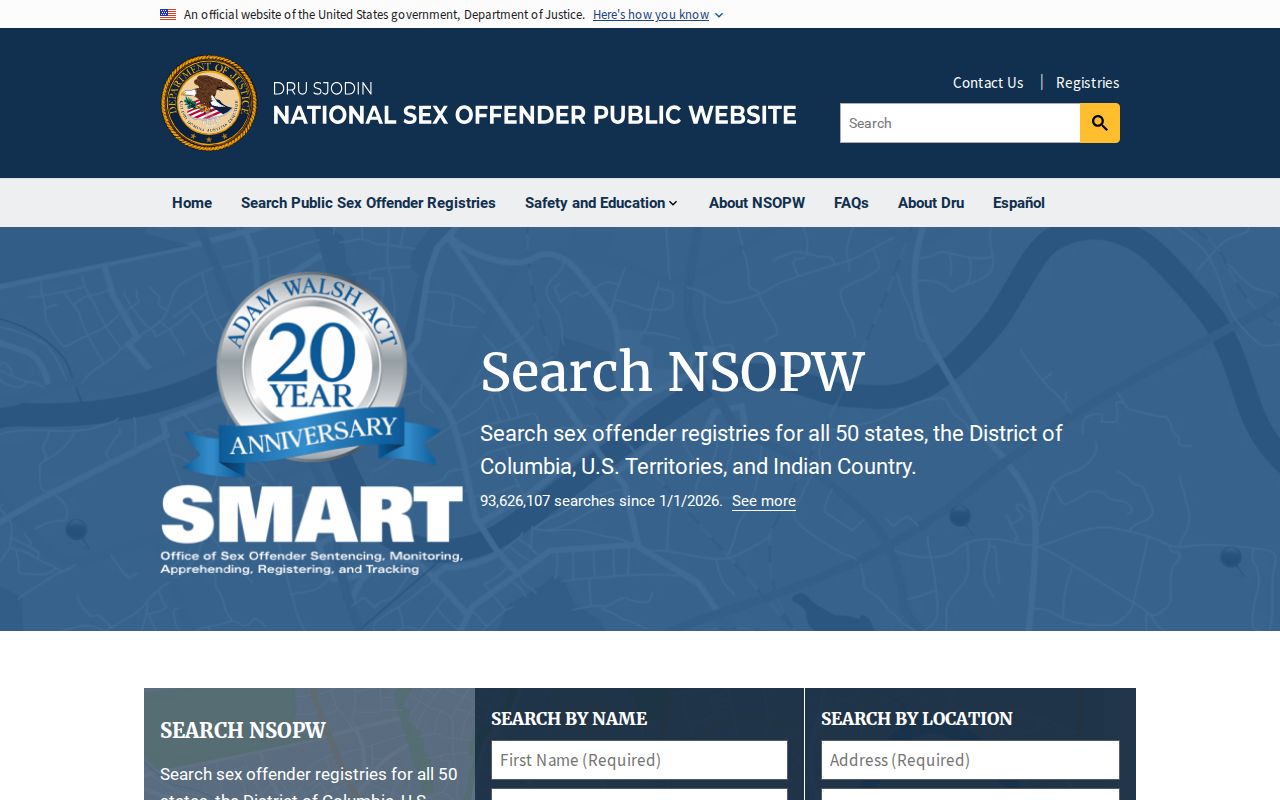
The national screen is best used to find possible records across state lines. Return to SORT and the Lexington County Sheriff for South Carolina details, current compliance questions, or corrections. NSOPW does not turn separate state systems into one uniform record. Each participating jurisdiction controls the facts it supplies, its public fields, and its update process.
Registration Requirements and Levels in South Carolina
Current SLED guidance describes adult Tier I, II, and III routes. The periods below mark the earliest possible removal path, not an automatic end date. The person must keep registering until formal written removal is granted. Out-of-state and federal cases use the equivalent federal SORNA tier, while juvenile matters follow separate Family Court and statutory rules affected by the 2025 amendments.
| Tier or Category | Earliest Route | Decision Channel |
|---|---|---|
| Adult Tier I | After 15 qualifying years | Administrative SLED request |
| Adult Tier II | After 25 qualifying years | Administrative SLED request |
| Adult Tier III | After 30 qualifying years | General Sessions motion; no administrative SLED route |
| Out-of-state or federal | Equivalent federal SORNA tier applies | Special removal rules |
| Juvenile | Separate statutory criteria | Family Court and rules affected by 2025 changes |
Senate Bills 28 and 29, signed in May 2025, added Tier I offenses and changed adult and juvenile removal criteria. Always use current SLED guidance rather than an older summary.
Lexington County Registry Removal Records
An administrative removal request is a document-heavy process. SLED requires its paper application, two recent FD-258 fingerprint sets, disposition and sentencing records, proof that required treatment was completed, and a $250 nonrefundable cashier's check or money order. SLED describes a 120-day review after a complete submission. A denial can generally be renewed no sooner than five years later. Judicial review goes to General Sessions rather than an internal SLED appeal.
Tier III removal follows a General Sessions motion, not the Tier I or II administrative route. That distinction makes the court of conviction and the current tier important before records are ordered. Registration continues during review. An application, fingerprints, or elapsed time alone does not change public status. The final written decision controls.
Note: Keep registering until SLED or the court issues formal written removal; a pending request does not suspend any registration duty.
Lexington County Registry Notifications
Community notifications can turn a one-time Lexington County sex offender check into an ongoing safety tool. The current SORT system provides a notification signup alongside its search functions. Because SLED states that the new system requires a new registration, an old alert account should not be assumed active. Enter the location details requested by SORT, then keep contact information current so the system can deliver notices.
Alerts are a prompt to check the official profile. They are not a finding of a new crime, and they do not prove that a listed person is at a map point at that instant. Review the profile's date, status, aliases, and registering jurisdiction. Report a suspected compliance issue through the sheriff or SLED SOR Unit. For an immediate threat, use the proper emergency channel rather than a registry contact address.
Lawful Use and Community Notification
The registry serves public awareness and safety planning. Lawful use starts with accurate matching, respect for the published conditions, and official reporting when facts appear wrong. Never use an entry as a reason to threaten, follow, shame, or harm a registrant or anyone in that person's home. SLED expressly warns against unlawful injury and harassment. A past qualifying conviction also does not establish a new offense.
Misuse can add criminal penalties: S.C. Code §23-3-510 allows up to $1,000 and six months to be added when registry information is used to commit a misdemeanor, or up to five years when it is used to commit a felony.
Use the Lexington County registry to make calm, fact-based safety choices. Send compliance concerns to law enforcement. If a record seems inaccurate, ask the agency that maintains it to review the source data rather than spreading an unverified claim.